
Selling Your Manufacturing Business Without Losing Your Legacy
For many manufacturing business owners, selling the company is about far more than achieving the highest possible purchase price.
You may have spent 20, 30, or 40 years building the business. Some employees may have worked alongside you for decades. Customers and suppliers may have become personal relationships. Your company may be an important employer in your community and, in many cases, represents not only the largest financial asset you own but a significant part of your identity and your family’s history.
So, when it comes time to consider selling your manufacturing business, one of the most difficult questions often isn’t:
“What is my business worth?”
It’s:
“What happens to everything I’ve built after I sell it?”
That’s a legitimate concern.
The good news is that protecting your legacy and successfully monetizing the value you’ve created don’t have to be mutually exclusive. But accomplishing both requires approaching the sale process intentionally and recognizing that choosing the right buyer can be just as important as negotiating the right purchase price.
Start by Defining What “Legacy” Means to You
Every business owner defines legacy differently.
For one owner, protecting the legacy may mean keeping the company’s name on the building. For another, it means protecting longtime employees. Others care deeply about maintaining the company’s location, preserving customer relationships, continuing a particular product line, or making sure the business remains an important employer in the local community.
Before going to market, determine which of these things actually matter to you.
Ask yourself:
- Do I want the company to remain in its current location?
- How important is retaining existing employees?
- Are there key managers I want to see rewarded or given opportunities to advance?
- Does maintaining the company name matter to me?
- Are there customers, suppliers, or community relationships I want protected?
- Do I want to remain involved after closing?
- Would I accept a somewhat different economic structure for a buyer I believe is a significantly better long-term steward of the business?
There are no universally correct answers.
But if you don’t know your priorities before entering a sale process, it becomes very difficult to evaluate buyers on anything other than price.
This is particularly important today as many founder-owned manufacturing companies across the Midwest approach succession at the same time. As I discussed recently in The Midwest Manufacturing Succession Crisis Is Accelerating, the question facing many owners is no longer simply whether their business can be sold, but whether they have prepared the company and its leadership for a successful transition to the next generation of ownership.
The Highest Offer Isn’t Always the Best Offer
One of the biggest misconceptions about selling a manufacturing company is that the process simply comes down to finding whoever will pay the most.
Price obviously matters. For most owners, decades of personal and financial investment are tied up in the company, and maximizing value should absolutely be an important objective.
But two offers with the same headline purchase price can represent very different outcomes.
Consider the difference between a buyer who intends to operate your company as a standalone business and one who plans to immediately consolidate operations into another facility.
Or a strategic buyer that already understands your industry compared with a financial buyer that sees your company as a platform for future acquisitions.
Or a buyer that wants you out six months after closing compared with one that values your experience and wants you involved for several years.
Purchase price itself can also be deceiving. Cash at closing, seller financing, earnouts, rollover equity, working capital requirements, employment agreements, real estate, and other transaction terms can materially change the economics and risk of an offer.
These aren’t necessarily good or bad outcomes. They are simply different.
Understanding a buyer’s plans for the business should therefore be part of evaluating an offer—not something you wait to discover during due diligence.
A Competitive M&A Process Creates More Than a Higher Price. It Creates Choice.
A well-run M&A process should create competition, but competition isn’t valuable solely because it can increase price.
It also creates choice.
When multiple qualified buyers are evaluating a business, an owner gains the ability to compare far more than valuation. You can evaluate:
- Purchase price and cash at closing
- Deal structure and financing certainty
- Employee retention plans
- Plans for the existing facility
- Strategic vision for the company
- Cultural compatibility
- Expectations for the seller after closing
- Experience operating manufacturing businesses
- Reputation and track record with previous acquisitions
This is one reason simply responding to the first unsolicited offer that arrives in your inbox can be risky. As buyer interest in Midwest manufacturing businesses has increased, owners are increasingly being approached directly by strategic buyers, private equity groups, family offices, and individual acquisition entrepreneurs.
I recently explored this trend in Why Buyers Are Aggressively Pursuing Midwest Manufacturing Companies. Strong buyer demand can create a tremendous opportunity for an owner—but only if that demand is turned into a structured process that allows the seller to evaluate multiple alternatives.
Buyer Selection Matters More in Manufacturing Than Many Owners Realize
Manufacturing businesses are complicated.
A buyer isn’t simply acquiring an income statement.
They’re acquiring equipment, skilled employees, production processes, engineering knowledge, quality systems, supplier relationships, customer qualifications, inventory, working capital requirements, maintenance needs, institutional knowledge, and often decades of reputation within a specialized industry.
A buyer who understands those realities may approach ownership very differently from someone looking at the company primarily through a spreadsheet.
This is why buyer fit matters.
A strategic buyer may see capabilities within your company that complement an existing operation. A private equity-backed platform may bring capital, professional management resources, and acquisition opportunities. A family office may have a much longer investment horizon. An individual entrepreneur may want to personally operate the company and continue the culture established by the founder.
None is automatically the “right” buyer.
The right buyer is the one whose capabilities, resources, transaction structure, and plans for the company best align with the seller’s objectives.
Your Employees Are Often Part of What the Buyer Is Purchasing
One of the most common concerns I hear from manufacturing owners is:
“What is going to happen to my employees?”
That’s understandable. In many closely held manufacturing companies, employees aren’t simply names on a payroll report. Owners have worked alongside them for years or decades and know their families personally.
Fortunately, in many lower-middle-market manufacturing transactions, an experienced workforce isn’t a liability.
It’s one of the most valuable assets the buyer is acquiring.
Experienced machinists, engineers, technicians, welders, supervisors, estimators, quality personnel, salespeople, and other skilled employees can be extremely difficult to replace. A buyer may view the workforce and management team as essential to preserving the value of the acquisition.
That’s why employee retention and leadership continuity deserve attention well before a transaction closes. I discussed this in greater detail in Employee Retention and Leadership Alignment in Manufacturing M&A, including the importance of communication, management alignment, retention planning, and maintaining operational stability throughout a transition.
Building a Business That Doesn’t Depend on You Protects Both Value and Legacy
There’s an interesting connection between protecting your legacy and maximizing your company’s value:
Many of the things that make a manufacturing company more valuable also make it more likely to succeed without its founder.
A capable management team, documented processes, strong financial reporting, institutionalized customer relationships, a stable workforce, modern equipment, and disciplined operating systems all reduce the risk associated with an ownership transition.
They also reduce buyer dependence on the seller.
This matters because sophisticated buyers don’t simply evaluate EBITDA. They evaluate the risk associated with continuing that EBITDA after ownership changes.
A company in which the founder personally handles every major customer relationship, prepares every quote, manages every employee, approves every purchase, and possesses most of the technical knowledge presents a very different risk profile than a company with a capable team and repeatable systems.
Those differences can directly affect valuation.
In Why Some Manufacturing Businesses Sell for Premium Multiples While Others Struggle, I discussed many of these qualitative factors and why companies with management depth, customer diversification, strong systems, and lower owner dependence often generate stronger buyer interest and better valuations.
Owners who want to understand where their own company stands can also benefit from completing a Market Value Assessment years before a planned sale. Understanding current value is important, but identifying the operational factors increasing—or suppressing—that value can be even more useful when there is still time to make improvements.
Your Transition Can Help Protect What You Built
Selling your business also doesn’t necessarily mean handing over the keys on Friday and disappearing on Monday.
Manufacturing businesses often contain decades of institutional knowledge that can’t be transferred through a closing binder.
You may understand why a particular customer orders the way they do, which machine performs best for a difficult job, which supplier can solve an emergency, which employees have untapped leadership potential, or why a process that looks inefficient on paper exists for a very good reason.
A thoughtful transition allows that knowledge to move from seller to buyer.
Depending on your goals and the transaction, that could mean a short transition period, a consulting arrangement, or continued employment for a longer period.
The important thing is determining what you want before selecting a buyer and negotiating the transaction.
Some owners are ready to retire immediately. Others want to continue working for several years without carrying the responsibility and financial risk of ownership. Some want to remain involved strategically while handing day-to-day management to the buyer.
All can work.
The transition simply needs to be discussed early enough that buyer selection and transaction structure support the owner’s desired outcome.
What Protecting a Legacy Looks Like in a Real Transaction
These concepts aren’t theoretical.
In one recent Summit Capital Advisors transaction, we represented the owners of a specialized sheet metal processing and slitting business that had built a strong reputation, experienced workforce, repeat customer base, and specialized processing capabilities over more than 15 years.
The owners were nearing retirement and wanted to exit completely following the sale. That made buyer selection particularly important.
Rather than simply looking for financial capacity, the process focused heavily on strategic buyers that understood metals distribution and processing and had the infrastructure and industry knowledge to successfully operate the business after the owners departed.
The ultimate buyer was already involved in metals distribution and viewed the acquisition as an opportunity to vertically integrate slitting and processing capabilities. The buyer acquired not simply financial performance, but valuable equipment, an experienced workforce, established customers, and capabilities that could be expanded under new ownership.
The sellers achieved the retirement they wanted while leaving the business positioned for continued investment and growth.
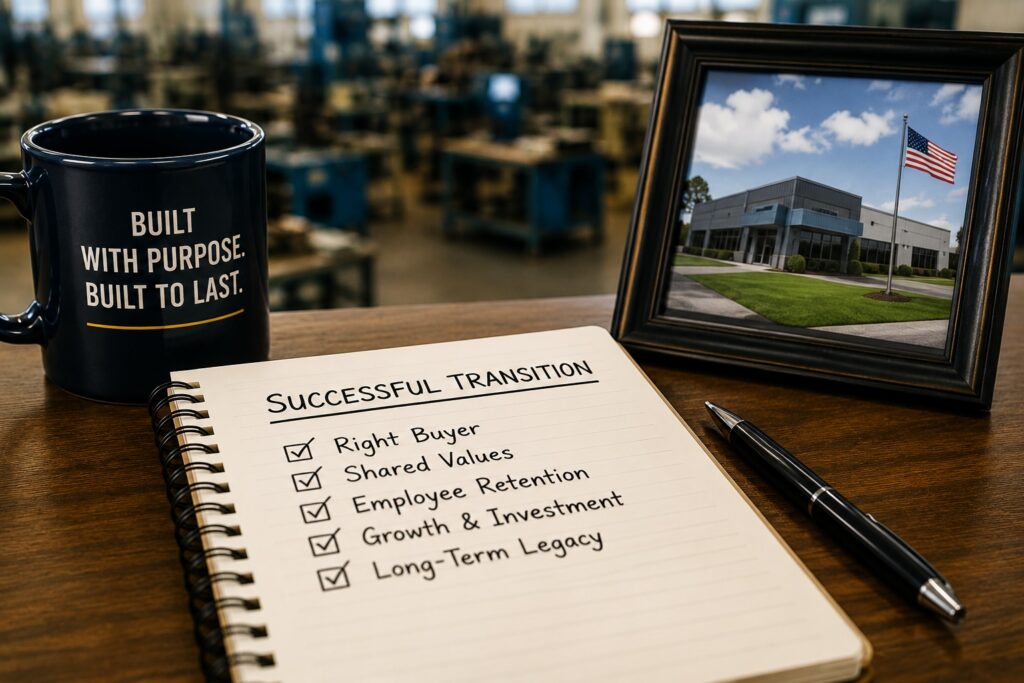
That’s what a successful transition should accomplish.
Owners considering a future exit can explore additional manufacturing and industrial transaction case studies to see how different businesses, buyers, challenges, and seller objectives have been addressed across completed Summit Capital Advisors transactions.
Protecting Your Legacy Starts Years Before You Sell
Some of the best legacy protection happens long before a company ever goes to market.
Building a strong management team, documenting processes, diversifying customer relationships, investing in equipment, developing younger employees, strengthening financial reporting, and reducing dependence on the owner all make a company more transferable.
They also give the next owner a stronger foundation to build upon.
This is one of the central themes I discuss in American-Made Millions: How to Unlock the True Value of Your Manufacturing Business Before Selling.
The premise is simple: the best time to prepare your manufacturing company for a successful exit is well before you’re ready to sell.
Owners who begin preparing several years in advance have something owners forced into a transaction don’t have:
Options.
They have time to address weaknesses, develop management, improve financial performance, understand valuation, reduce risk, and ultimately decide when—and whether—the right opportunity has arrived.
A Successful Exit Should Accomplish More Than a Number
After spending decades building a manufacturing company, you deserve to realize the financial value of what you created.
But that doesn’t mean you have to ignore everything else that matters to you.
A successful transaction can provide financial security for you and your family while creating new opportunities for employees, giving the business access to additional capital and resources, strengthening customer relationships, and positioning the company for another generation of growth.
In some cases, the next owner may ultimately take the company further than you could have on your own.
That’s not losing your legacy.
That’s extending it.
The objective shouldn’t simply be to sell your manufacturing business.
It should be to find the right buyer, negotiate the right transaction, and transition the company in a way that allows you to walk away knowing that you were appropriately rewarded for what you built—and that the business has the opportunity to continue succeeding long after the transaction closes.
Thinking About Selling Your Manufacturing Business?
Whether you’re ready to sell today or believe an exit may still be several years away, the best first step is understanding your options.
Summit Capital Advisors specializes in advising lower-middle-market manufacturing, industrial, distribution, and B2B service business owners throughout the Great Lakes and Midwest. We help owners understand value, prepare their companies for market, identify and qualify buyers, negotiate transaction structure, navigate due diligence, and ultimately execute a successful transition of ownership.
If you’re beginning to think about what the next chapter could look like, we welcome the opportunity to have a confidential conversation about your business, your goals, and the legacy you want to leave behind. Schedule a Free Confidential Consultation