
New SBA Rules Take Effect October 1: What They Could Mean for Manufacturing M&A
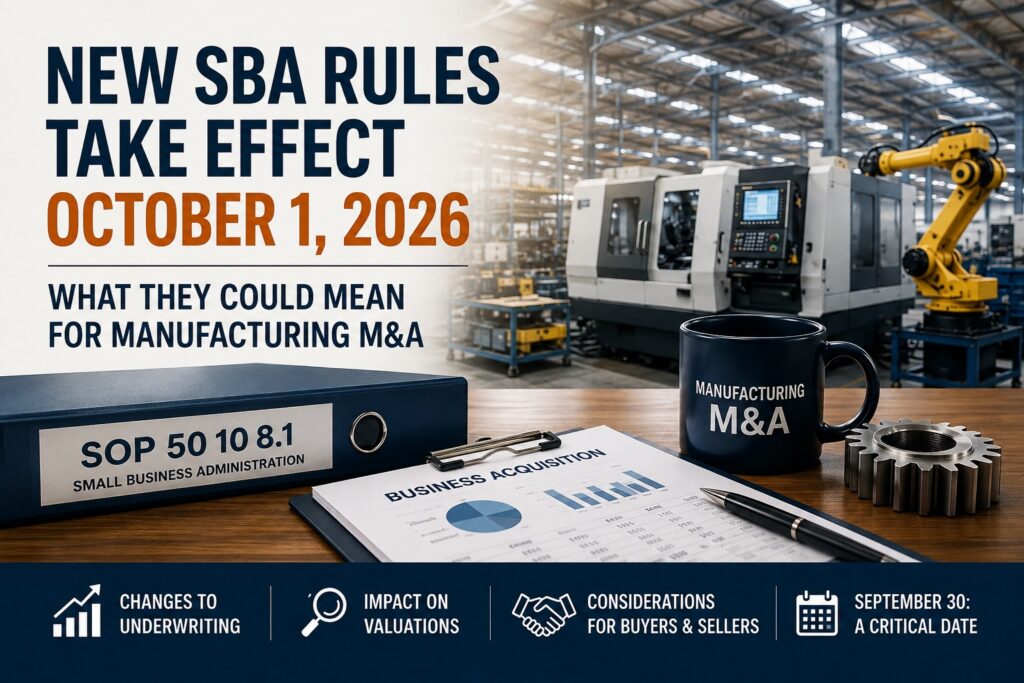
The U.S. Small Business Administration released SOP 50 10 8.1 on August 14, 2026, introducing several meaningful changes to how SBA-backed business acquisitions will be structured and underwritten beginning October 1.
For manufacturing and industrial business owners and buyers, these changes deserve attention. SBA financing plays an important role in lower-middle-market M&A, particularly at the smaller end of the market where conventional acquisition financing can be difficult to obtain. Changes to SBA underwriting standards can therefore affect much more than lending. They can influence business valuations, buyer pools, deal structures, due diligence, transaction timelines and ultimately which deals get completed.
There are both positives and negatives in the new rules. Some changes could make acquisitions more difficult for first-time buyers or buyers stretching to support a purchase price. Others may create advantages for established manufacturing companies pursuing strategic or bolt-on acquisitions.
There is also an immediate issue for deals already in process. SOP 50 10 8.1 becomes effective October 1, 2026, making September 30 an important date for buyers and sellers currently pursuing an SBA-financed transaction.
What Is Changing?
The new SBA SOP 50 10 creates a more defined framework around change-of-ownership transactions, with different treatment depending on the type of acquisition. A first-time buyer acquiring a company does not necessarily face the same underwriting requirements as an established operating business acquiring another company as an expansion.
For lower-middle-market manufacturing and industrial transactions, some of the most important changes include:
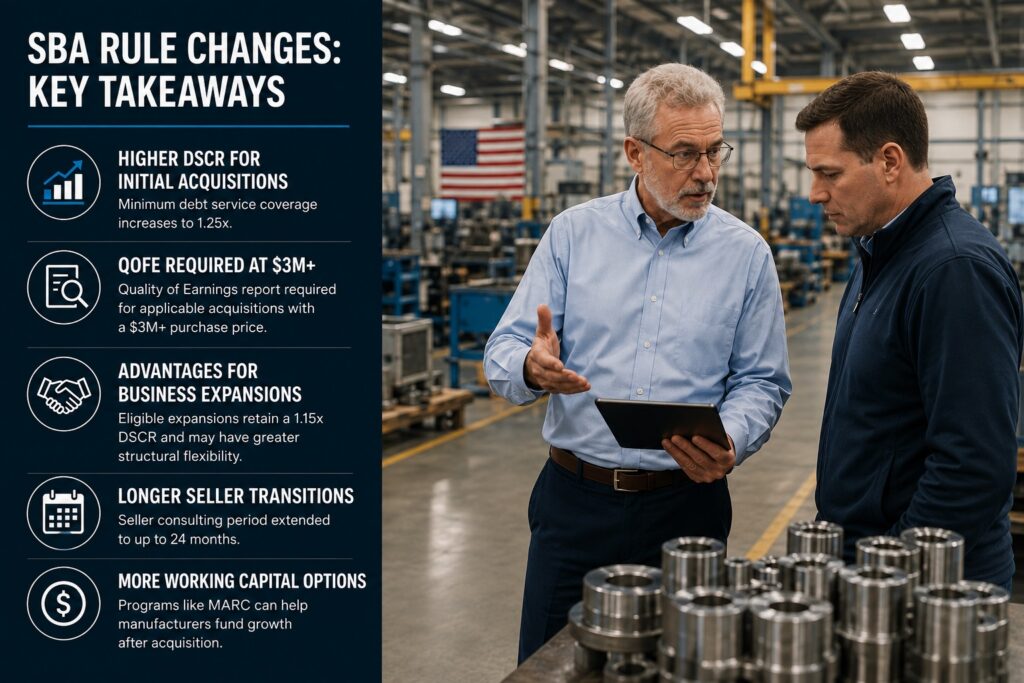
- Higher debt service requirements for Initial Acquisitions. The minimum debt service coverage ratio increases to 1.25x, putting additional emphasis on whether historical cash flow can support the acquisition debt.
- More financial diligence on larger transactions. Initial Acquisitions and Business Expansions with a business purchase price of $3 million or greater will generally require a lender-commissioned Quality of Earnings report in addition to the required business valuation.
- Different treatment for qualifying Business Expansions. Established businesses making qualifying expansion acquisitions can continue to be evaluated at a 1.15x debt service coverage requirement and may receive other structural advantages.
- Longer allowable seller transition periods. A departing seller may serve as a consultant for up to 24 months, compared with the previous 12-month limitation.
- More standardized acquisition underwriting. Change-of-ownership transactions will move through Standard 7(a) processing rather than using the 7(a) Small underwriting path.
Taken together, I don’t view the changes as simply making SBA acquisition financing better or worse. Instead, they change where the advantages are and where the SBA is placing additional controls around acquisition risk.
Higher Debt Service Requirements Could Put Pressure on Some Deals
One of the most important changes for first-time acquisition buyers is the increase in the minimum debt service coverage ratio to 1.25x for Initial Acquisitions. The difference between 1.15x and 1.25x may not sound dramatic, but it can meaningfully reduce the amount of acquisition debt a company’s historical earnings can support.
Buyers also should not assume projected post-closing improvements will solve a historical cash flow problem. A buyer may have a credible plan to increase prices, reduce expenses, improve throughput or generate synergies after closing, but those expected improvements don’t necessarily create additional historical cash flow to support the acquisition debt.
For sellers, this could put pressure on valuations where the purchase price is already stretching the company’s historical cash flow. If the business cannot support enough acquisition debt at the agreed purchase price, the buyer may need to contribute more equity, the seller may be asked to provide additional financing, the transaction may need to be restructured, or the purchase price may need to come down.
That doesn’t mean SBA-financed manufacturing valuations suddenly decline October 1. Strong companies attracting well-capitalized strategic, private equity or family office buyers may see little direct impact. Smaller businesses whose buyer pools consist predominantly of individual SBA-financed buyers could feel the effects much more directly.
This reinforces an important point for sellers: it isn’t enough to know what your business may be worth. You also need to understand who is most likely to buy it and how those buyers are likely to finance the acquisition.
The New $3 Million Quality of Earnings Requirement
One of the most significant changes for lower-middle-market transactions is the new Quality of Earnings, or QofE, requirement.
For applicable Initial Acquisitions and Business Expansions with a business purchase price of $3 million or greater, the lender will need to obtain a Quality of Earnings report in addition to the required independent business valuation. Importantly, the threshold applies to the business purchase price and does not include owner-occupied commercial real estate being acquired as part of the transaction.
This is particularly relevant in manufacturing because privately held manufacturing companies frequently have legitimate normalization adjustments in their financial statements. Those may include:
- owner and family compensation
- personal vehicles and discretionary expenses
- related-party rent adjustments
- one-time equipment repairs
- unusual legal or professional fees
- nonrecurring operating expenses
- owner-specific benefits
- unusual project or customer activity
These adjustments are common in lower-middle-market M&A and many are completely legitimate. However, sellers should expect greater scrutiny around whether they are adequately documented and truly representative of expenses that will not continue under new ownership.
That isn’t necessarily bad news for sellers. A manufacturing company with clean financial statements, well-supported adjustments and highly defensible earnings may actually benefit because the additional diligence validates the quality of the company’s earnings. A business whose valuation depends heavily on aggressive add-backs or poorly documented adjustments may have a much harder time.
The $3 million threshold also creates an interesting divide. A manufacturing company valued at $2.8 million and another valued at $3.2 million may now face meaningfully different diligence requirements when the buyer is using SBA financing.
I would not recommend trying to artificially structure around the threshold. The better response is to assume financial scrutiny will continue increasing and prepare your manufacturing business for a sale accordingly.

Strategic and Bolt-On Buyers May Actually Benefit
Not everything in SOP 50 10 8.1 makes acquisitions harder. One of the more interesting changes is the treatment of qualifying Business Expansion transactions.
An established operating company acquiring another business within the applicable industry classification may qualify as a Business Expansion rather than an Initial Acquisition. These transactions retain a 1.15x debt service coverage requirement rather than the 1.25x requirement applicable to Initial Acquisitions and may receive additional flexibility around the required equity contribution depending on the circumstances.
This could be particularly meaningful in manufacturing. Consider a successful precision machine shop acquiring another machine shop, a fabrication company acquiring a complementary fabricator, or an industrial company acquiring a business that expands its capabilities, customers or geographic reach.
An established operating company already has management, infrastructure, industry experience, banking relationships and an operating history that a first-time acquisition entrepreneur may not have. From a risk perspective, those are fundamentally different acquisitions.
This could make SBA financing an increasingly interesting tool for established manufacturing companies pursuing smaller strategic or bolt-on acquisitions, particularly when the buyer wants to preserve its own liquidity for working capital and post-closing investment.
Working Capital and Seller Transitions Matter in Manufacturing
Buying a manufacturing company is only part of the capital requirement. A buyer may also need significant liquidity following closing to fund inventory, payroll, raw materials, accounts receivable, capital expenditures and growth. A transaction that consumes nearly all of the buyer’s available liquidity at closing can leave an otherwise healthy company undercapitalized immediately after the acquisition.
This is particularly relevant given the SBA’s broader efforts to expand access to capital for manufacturers, including the Manufacturers’ Access to Revolving Credit, or MARC, program, designed to provide eligible small manufacturers with flexible working capital financing. Combined with the treatment of qualifying Business Expansions, these programs could create interesting opportunities for established manufacturers using SBA financing as part of a broader acquisition and growth strategy.
Another positive change for manufacturing transactions is the extension of the allowable seller consulting period from 12 months to 24 months. Manufacturing businesses frequently have significant institutional knowledge tied to their owners, including customer relationships, quoting knowledge, supplier relationships, technical expertise and production processes.
For sellers who want to transition gradually, or buyers concerned about losing critical knowledge after closing, the ability to structure a longer consulting relationship could reduce transaction risk for both sides.
What Manufacturing Business Sellers Should Consider
For manufacturing owners considering a sale, these changes reinforce the importance of preparing before going to market. The quality of the company’s financial reporting and the defensibility of its earnings are becoming increasingly important.
A few things I would focus on as a seller include:
- Know your Adjusted EBITDA. Understand every adjustment being made and make sure it can be supported.
- Clean up the financial statements. Buyers, lenders and QofE providers should be able to move from tax returns and financial statements to normalized earnings without solving a puzzle.
- Document add-backs. Maintain support explaining exactly what an adjustment represents and why it should not continue under new ownership.
- Understand your likely buyer pool. These changes matter much more if your likely buyers are predominantly individuals using SBA financing than if the business is attracting strategic or institutional buyers.
- Evaluate financing certainty when comparing offers. The highest purchase price isn’t necessarily the best offer if the buyer is stretching SBA underwriting standards to make the transaction work.
That last point is particularly important. Certainty of closing has value. A slightly lower offer from a well-capitalized buyer with a highly executable financing plan may ultimately be more valuable than a higher offer that requires everything to go perfectly during underwriting.
What Manufacturing Business Buyers Should Consider
Buyers should begin underwriting acquisitions to the new standards now if there is any realistic possibility their transaction will receive an SBA loan number after September 30.
First-time buyers should pressure-test debt service coverage before making an aggressive offer and scrutinize seller add-backs earlier in the process. If a $3 million-plus transaction is ultimately going through an independent QofE, aggressive adjustments are likely to be challenged eventually. It is better to identify that issue before signing an LOI than several months into diligence.
Established business owners should also ask their lender whether a proposed acquisition qualifies as a Business Expansion. The answer could materially affect the required debt service coverage, equity contribution and overall economics of the transaction.
Finally, don’t overlook post-closing liquidity. The goal isn’t simply to finance the purchase price. The buyer needs enough capital to operate and grow the business after closing.
Have an SBA Financed Deal Underway? September 30 Matters
For buyers and sellers with transactions already under LOI or in due diligence, this may be the most immediately important part of the announcement.
SOP 50 10 8.1 becomes effective October 1, 2026. The transition is based on when the transaction receives its SBA loan number, making September 30 the critical date for transactions seeking to remain under the current SOP.
That does not mean September 30 should be viewed as the date to submit the loan application. If you have a transaction in process and believe the current SOP provides a more favorable structure, I would work backward from September 30 and build in a meaningful cushion for missing documentation, underwriting questions or other delays.
The objective isn’t to have an application sitting on someone’s desk September 30. The objective is to have the SBA loan number assigned by then.
If you have an SBA-financed acquisition underway, I would recommend discussing the following with your lender now:
- Which SOP is more favorable for this particular transaction? Don’t assume the current rules are automatically better.
- What does the lender still need to obtain the SBA loan number? Get a specific list of outstanding documents and requirements.
- What internal deadline does the lender recommend? Work backward from September 30 rather than treating it as the submission date.
- Are there underwriting issues that could delay issuance of the loan number? Identify and address them now.
- Does the transaction still work under SOP 50 10 8.1? Run the deal both ways so there isn’t a surprise if timing slips.
- Does the LOI or purchase agreement provide enough flexibility? Understand what happens if financing changes affect the purchase price, equity requirement, seller financing or closing timeline.
If a transaction only works under the current SOP, both parties should understand that risk today rather than discovering it in late September. Conversely, there may be transactions where provisions of the new SOP, including the Business Expansion treatment or longer seller transition, are actually advantageous.
The key is to understand the difference before the deadline dictates the answer for you.
The Bigger Picture for Manufacturing M&A
I don’t view SOP 50 10 8.1 as universally good or bad for manufacturing M&A. For first-time buyers relying heavily on leverage, acquisitions may become more difficult. Businesses with aggressive EBITDA adjustments or valuations requiring optimistic projections may also face greater financing challenges, while additional diligence requirements could increase transaction costs and timelines.
On the other hand, sellers with clean financials and highly defensible earnings may benefit from additional diligence validating the quality of their business. Established manufacturers pursuing strategic acquisitions may find SBA financing more attractive, and longer seller transition periods could reduce risk in businesses where institutional knowledge takes time to transfer.
The broader lesson is that financing, valuation and deal structure cannot be viewed independently. A manufacturing business’s value is influenced by its earnings, risk profile, assets, customers, management team and growth opportunities, but ultimately a buyer also needs to be able to finance the transaction.
When financing standards change, the M&A market responds.
SOP 50 10 8.1 takes effect October 1. For anyone buying or selling a manufacturing or industrial business with SBA financing in the conversation, now is the time to understand what the new rules could mean for your deal.