
Q2 2026 M&A Market Update: Buyer Demand Remains Strong for Manufacturing Businesses
The latest M&A market data provides encouraging news for owners of quality manufacturing and industrial businesses considering a sale.
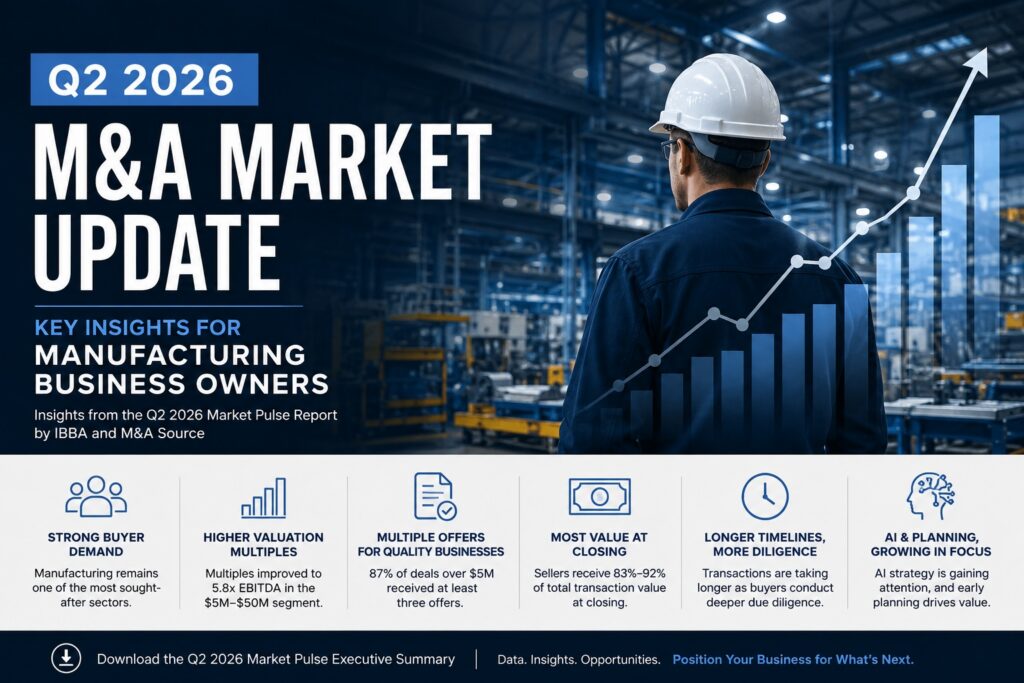
The Q2 2026 Market Pulse Report, produced by the International Business Brokers Association (IBBA) and M&A Source, shows a market that continues to favor sellers in the Lower Middle Market. Buyer competition remains strong, valuation multiples have improved at the upper end of the market, and sellers continue to receive the vast majority of their transaction value at closing.
For manufacturing business owners, there is an even more compelling takeaway: manufacturing remains one of the most sought-after sectors in today’s M&A market.
At the same time, buyers aren’t chasing every company that comes to market. They remain selective about financial performance, management depth, growth opportunities, customer concentration, operating risk, and overall business quality. The result is a market that can be very rewarding for the right business, particularly when the owner has taken the time to prepare.
The Q2 2026 Market Pulse Survey was conducted July 1–15, 2026 and included responses from 255 business brokers and M&A advisors reporting 181 completed transactions. The report studies transactions ranging from less than $500,000 to $50 million in enterprise value.
Here are the findings I believe matter most for manufacturing business owners.
Lower Middle Market Conditions Continue to Favor Sellers
One of the clearest takeaways from the Q2 report is the growing divide between smaller Main Street transactions and the Lower Middle Market.
In Q2 2026, 72% of advisors handling transactions valued between $2 million and $5 million described conditions as a seller’s market. That increased to 76% for transactions between $5 million and $50 million. Both measures improved from the prior year.
A seller’s market doesn’t mean every business will receive a premium valuation or that owners can simply name their price. It means demand for quality acquisition opportunities is exceeding the available supply, giving strong businesses greater negotiating leverage.
There is plenty of capital available in today’s M&A market, but buyers remain disciplined. They’re willing to compete aggressively for quality companies and equally willing to walk away when the valuation, financial performance, or risk profile doesn’t make sense. For owners of well-run manufacturing businesses, however, the current supply-and-demand dynamic continues to create a favorable environment.
Good Lower Middle Market Businesses Are Generating Multiple Offers
Perhaps the most compelling evidence of buyer demand is the number of offers businesses are receiving. The Q2 data shows a clear relationship between transaction size and buyer competition:
- Deals below $500,000 averaged 1.7 offers
- Transactions between $2 million and $5 million averaged 4.85 offers
- Transactions between $5 million and $50 million averaged 5.47 offers
- 87% of deals above $5 million attracted at least three offers
- 33% of deals above $5 million attracted 10 or more bids
This is why I believe running a competitive sale process is so important. Selling a business isn’t simply about finding someone willing to buy it. The objective should be to create enough qualified buyer interest that an owner can compare competing offers across the factors that ultimately determine whether a transaction is successful:
- Purchase price
- Cash paid at closing
- Seller financing, earnouts, or rollover equity
- Financing certainty
- Transition requirements
- Cultural fit
- Treatment of employees
- Probability and timing of closing
The highest headline purchase price isn’t always the best transaction. Multiple qualified buyers create leverage, and leverage gives sellers the ability to negotiate not only for value, but also for the terms and outcome that best align with their objectives. Read recent closed deal case studies for real deal examples.
Valuation Multiples Are Holding Up and Improving at the Top of the Market
Valuation data was another encouraging part of the Q2 report. For transactions between $2 million and $5 million, the reported multiple was approximately 4.0x EBITDA. For transactions between $5 million and $50 million, the reported multiple increased from 5.5x in Q2 2025 to 5.8x in Q2 2026, the highest level reported since Q1 2022.
The underlying survey data similarly reports a median EBITDA multiple of 5.75x for the $5 million–$50 million segment, compared with 5.5x one year earlier.
Of course, market averages should never be confused with the valuation of a specific company. Some manufacturing businesses sell for premium multiples because buyers see differences in quality, risk, growth potential, and transferability that aren’t apparent from EBITDA alone. Two manufacturing businesses with identical revenue and EBITDA can command very different valuations based on factors such as:
- Customer and industry concentration
- Recurring and repeat revenue
- Historical growth and future growth opportunities
- Gross margins and EBITDA margins
- Management depth and owner dependence
- Equipment condition and future capital expenditure requirements
- Intellectual property or proprietary capabilities
- Competitive position and barriers to entry
- Working capital requirements
- Quality of financial reporting
Those factors ultimately determine what buyers are willing to pay, but the broader market data provides an important benchmark: quality Lower Middle Market businesses are still being rewarded.
Manufacturing Is One of the Most Sought-After Sectors in M&A
For manufacturing business owners, this may be the most important finding in the entire Q2 report.
As part of the survey, advisors were asked where they currently see buyer interest gaining or losing momentum. Across both transaction-size groups, manufacturing ranked among the sectors showing the strongest buyer interest.
For transactions below $10 million, 88% of respondents indicated that manufacturing was gaining buyer interest versus just 12% who saw interest declining. That resulted in a +76 net buyer-interest score, second only to B2B and business services at +77.
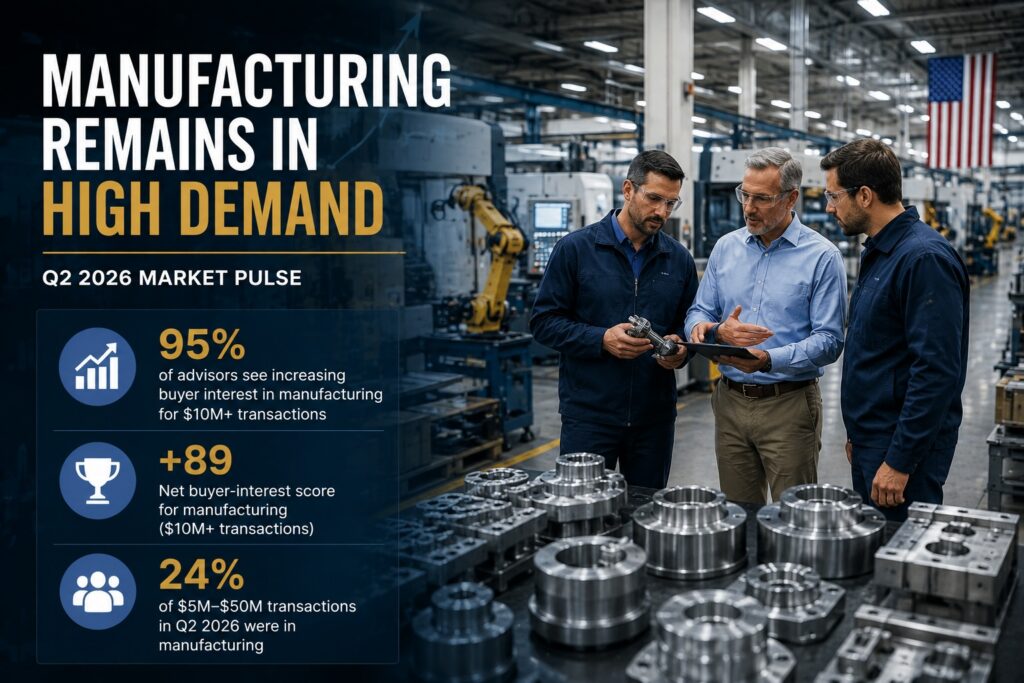
For transactions of $10 million or more, the results were even stronger. 95% saw buyer interest in manufacturing increasing versus just 5% decreasing, resulting in a +89 net score. Only distribution and wholesale ranked higher at +92.
The completed transaction data reinforces manufacturing’s importance as well. In the $5 million–$50 million segment, manufacturing represented 24% of reported Q2 transactions, making it the leading industry category in that segment.
This is consistent with what I continue to see in the market. Private equity firms, family offices, strategic acquirers, independent sponsors, and existing private-equity-backed portfolio companies continue to actively pursue quality manufacturing and industrial businesses.
There is significant capital looking for acquisitions, but that capital is selective. Buyers will compete for businesses with strong fundamentals, while companies with significant customer concentration, declining margins, weak financial reporting, excessive owner dependence, limited management depth, or other unresolved risks can still struggle to generate the same level of interest.
Sellers Are Receiving Most of Their Value at Closing
Purchase price gets most of the attention when owners think about selling a business, but deal structure deserves just as much.
The Q2 Market Pulse data shows that sellers received approximately 83% to 92% of total transaction value in cash at closing across the five market segments studied. Cash at closing includes buyer equity and senior debt, while seller financing accounted for less than 10% of most transactions during the quarter.
That’s significant because a $10 million purchase price doesn’t necessarily mean a seller receives $10 million at closing. An offer can include a seller note, earnout, rollover equity, escrow, holdback, or other contingent consideration that changes both the timing and risk associated with receiving the full purchase price.
When comparing offers, owners need to look beyond the headline number and understand:
- How much will I actually receive at closing?
- When will I receive the balance?
- What conditions have to be satisfied for me to receive it?
- How much risk am I carrying after I no longer own the company?
- What happens if the business underperforms after closing?
- How much control will I have over factors affecting an earnout or retained equity?
Price matters, but so do structure, certainty, and terms.
A Strong M&A Market Does Not Necessarily Mean a Fast M&A Market
One area where sellers should adjust their expectations is transaction timing. Deals are taking longer to close even as buyer demand remains healthy.
In Q2 2025, the median time from engagement to closing was approximately nine months for both the $2 million–$5 million and $5 million–$50 million segments. By Q2 2026, that had increased to approximately 11 months for both segments. For $5 million–$50 million transactions, the median period from LOI or offer to closing also increased from four months to five months.
I don’t view longer timelines as evidence that buyers have stepped away from the market. In many cases, buyers are investing significant amounts of capital to acquire quality businesses, and the more they’re willing to pay, the more thoroughly they’re going to validate what they’re buying.
Financial, tax, legal, operational, environmental, commercial, insurance, technology, cybersecurity, and human resources diligence can all become part of a Lower Middle Market transaction. The more issues that can be identified, addressed, and properly documented before buyers begin diligence, the better positioned a seller is to maintain momentum and negotiating leverage throughout the process.
This reinforces a recurring theme throughout the report: preparation matters.
AI Is Beginning to Enter the M&A Due Diligence Conversation
One of the more interesting new topics in the Q2 survey was artificial intelligence.
For transactions valued at $10 million or more, approximately 49% of advisors said buyers frequently or occasionally ask about the seller’s AI strategy. For transactions below $10 million, that figure was approximately 28%.
For most privately held manufacturers, this doesn’t mean buyers expect management to arrive with a sophisticated corporate AI strategy. But it does mean owners should increasingly understand how AI and other emerging technologies could affect their business.
For a manufacturing company, that discussion could include the use of AI in areas such as quoting and estimating, engineering, scheduling, purchasing, quality, sales and administrative functions. It also includes understanding the potential risks: what AI tools employees are already using, what company or customer information may be entered into those systems, and how management is protecting proprietary information and addressing cybersecurity concerns.
For most business owners, simply being able to demonstrate that management understands both the opportunities and risks will become increasingly important. I expect this to become a much more common diligence topic in the years ahead.
Retirement Is Driving Business Sales But Owners Still Aren’t Planning Early Enough
This may be the most important takeaway in the entire report for business owners.
Retirement remained the leading reason owners went to market across every transaction segment. It represented 72% of sales in the $1 million–$2 million segment, 70% in the $2 million–$5 million segment, and 65% in the $5 million–$50 million segment.
Yet despite retirement being a relatively predictable event, most owners are still entering the sale process with surprisingly little preparation. Across the five market sectors studied, 60% to 90% of sellers had completed less than one year of exit planning — or no formal planning at all — before engaging an advisor to sell.
That’s a tremendous missed opportunity.
For many manufacturing business owners, their company represents the largest financial asset they will ever own. Yet some of the factors that have the greatest impact on value simply can’t be fixed six months before a sale. Reducing customer concentration, building a management team, reducing owner dependence, improving margins, diversifying end markets, strengthening financial reporting, documenting processes, and building a credible growth strategy all take time.
That’s why exit planning shouldn’t begin when an owner decides they’re ready to sell. You don’t need to be ready to sell today to start preparing for a future transaction. In fact, the best time to begin is usually several years before you actually intend to go to market.
This is also one of the central themes behind my book, American-Made Millions: How to Unlock the True Value of Your Manufacturing Business Before Selling. The work an owner does before going to market can have just as much impact on the outcome as the sale process itself.

What Does the Q2 2026 M&A Market Mean for Manufacturing Business Owners?
Taken together, the Q2 data points to an attractive M&A environment for owners of quality Lower Middle Market manufacturing and industrial businesses:
- Buyer interest in manufacturing remains exceptionally strong
- Seller leverage continues to favor owners in the Lower Middle Market
- Good businesses are generating multiple offers
- Valuation multiples remain healthy and have increased at the upper end of the market
- Sellers continue to receive the majority of transaction value at closing
- Buyers remain active, but increasingly selective about quality and risk
For manufacturing business owners considering a sale over the next several years, that creates an opportunity, but it also reinforces the importance of preparation.
Understand what your business is worth today. Identify the risks a sophisticated buyer is likely to uncover. Strengthen the areas of the company that drive valuation. Address the issues that could create discounts, unfavorable deal terms, or problems during due diligence. And when the time comes to sell, run a competitive process designed to create leverage and identify the buyer offering the best overall combination of value, terms, certainty, and fit.
A strong market can create an opportunity. A strong business and a well-run process are what allow an owner to capitalize on it.
Want to Dig Deeper Into the Q2 2026 M&A Data?
Download the complete Q2 2026 Market Pulse Executive Summary from the International Business Brokers Association (IBBA) and M&A Source for additional data and insights on valuations, buyer competition, deal structures, transaction timelines, buyer profiles, industry trends, and the outlook for the M&A market.
Source: Q2 2026 Market Pulse Report, International Business Brokers Association (IBBA) and M&A Source. The Q2 2026 survey was conducted July 1–15, 2026 and included 255 completed responses and 181 reported completed transactions.